


Furrion Chill Cube Guide for Off-Grid RV Power
A rooftop air conditioner can be the difference between leaving a beautiful campsite at noon and staying put through the hottest part of the day. This Furrion Chill Cube guide focuses on the part that matters most for off-grid RVers: fitting the air conditioner into an electrical system that can actually support the way you travel.
The Chill Cube's variable-speed approach can make air conditioning more practical on battery power than many conventional rooftop units. But “more practical” does not mean unlimited runtime. Air conditioning is still one of the largest loads in an RV, and good results come from planning the battery bank, inverter, charging sources, wiring, and daily routine as one system.
What Makes the Chill Cube Different
Traditional RV rooftop air conditioners can hit the electrical system with a sharp startup demand, then run at a fairly fixed output. That startup event is often the problem for a smaller inverter, a lightly built battery bank, or a campground pedestal with weak power.
The Furrion Chill Cube uses variable-speed compressor technology to better match cooling output to demand. Once the rig begins to cool, it can reduce its effort rather than operating at full blast every moment. That can lower average power use under the right conditions and can be easier on an inverter and lithium batteries.
There is a trade-off worth keeping in view. The RV's insulation, window exposure, roof color, humidity, number of occupants, and outdoor temperature still determine how hard the system must work. In full sun on a 100-degree afternoon, the unit may need to run aggressively for long stretches. A more efficient air conditioner helps, but it cannot erase heat gain.
Start This Furrion Chill Cube Guide With Your Real Use Case
The first question is not, “How many solar panels do I need?” It is, “When do I expect to run the air conditioner, and for how long?” A traveler who wants cooling during lunch stops has a very different system requirement than a full-timer who wants quiet overnight cooling every night in the Southwest.
Consider the space you are cooling
A smaller, well-insulated travel trailer may reach a comfortable temperature quickly, especially when shades are down and the sun is not beating directly through the windshield or large windows. A larger motorhome, older rig, or RV with long duct runs may need more sustained cooling. Existing ductwork, return-air paths, and the condition of roof seals all deserve attention before selecting or installing any rooftop unit.
If your RV has more than one air conditioner, decide whether the goal is to run one unit from battery power or both. Designing around one Chill Cube is a realistic comfort upgrade for many off-grid setups. Supporting multiple air conditioners at once requires significantly more stored energy, inverter capacity, and charging capability.
Think in hours, not just amps
An air conditioner may draw a manageable amount of power at a given moment but consume substantial energy over several hours. That is why a system should be sized around total energy use, not just whether the AC will start.
A practical plan accounts for the air conditioner alongside the refrigerator, water pump, lighting, fans, microwave, coffee maker, computers, televisions, and any medical equipment. For remote workers, the daytime load may include monitors, cellular equipment, and charging devices precisely when the AC is working hardest. Those combined loads matter.
Nighttime changes the equation again. Solar production falls away, so the battery bank carries the entire load until morning. If overnight cooling is a priority, battery capacity and generator or shore-power recovery options usually matter more than adding a small amount of extra solar.
Build the Electrical System Around the Air Conditioner
A Chill Cube installation should be evaluated as part of the whole RV electrical system. The unit may be on the roof, but its success depends on what is below it.
Battery capacity needs usable energy
Lithium batteries are well suited to high-demand RV loads because they can deliver current efficiently and maintain voltage better than many older battery types. Still, the useful question is how much usable energy the battery bank provides after other overnight loads are included.
Battery-bank sizing is never one-size-fits-all. A couple who moves frequently and uses air conditioning for short daytime breaks may be satisfied with a different setup than a family staying several days in open desert sites. The desired runtime, weather conditions, and recharge plan should all be established before the battery bank is chosen.
The inverter must handle the job continuously
An inverter needs enough continuous output to run the air conditioner while supporting normal household loads that may be on at the same time. It also needs properly sized DC cables, overcurrent protection, disconnects, and battery connections. A large inverter installed with undersized cable or poor connections is not a solution.
Voltage drop on the DC side is especially important. High-power AC loads create high current demand from a 12-volt battery system. Neat cable routing, correct conductor sizing, solid terminations, and appropriate protection are not cosmetic details. They protect equipment performance and help prevent avoidable shutdowns.
The RV's existing electrical layout also matters. Some rigs need changes to how circuits are fed by the inverter. Others may need an upgraded shore-power integration strategy so the system behaves properly when plugged in, on generator power, or operating from batteries. This is where a requirements-first design prevents surprises after installation.
Solar replaces energy, but not instantly
Solar is excellent for extending off-grid time, particularly during clear, sunny travel seasons. It can cover a meaningful share of daytime air-conditioning demand when panel capacity, battery storage, and sunlight all line up. But solar output changes with shade, panel temperature, season, roof space, and the position of the sun.
It is better to view solar as a recharge source than a promise of nonstop air conditioning. The battery bank absorbs changing loads, while solar charge controllers replace energy as conditions allow. For air-conditioning-focused systems, alternator charging, shore power, or a generator can also be valuable recovery tools when clouds or heavy heat stretch the energy budget.
Installation Details That Affect Cooling and Power Draw
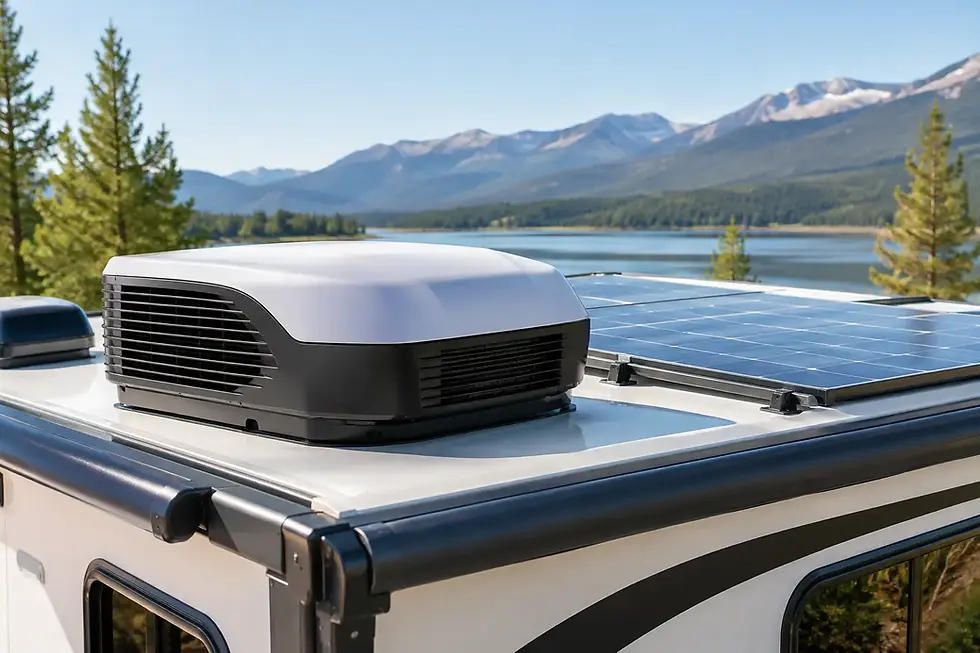
The rooftop opening is only one part of a proper Furrion Chill Cube installation. The roof structure must be sound, the gasket must seal evenly, and the mounting process must protect the roof from water intrusion. A quality installation also verifies compatibility with the RV's ducted or non-ducted configuration and makes sure return air is not restricted.
Inside the RV, the electrical circuit should be inspected rather than assumed to be correct. Breaker sizing, wire condition, connections, and control wiring all need to match the equipment requirements. If the unit will be supported by an inverter, the installer should confirm exactly which circuits are powered in inverter mode and how the system transitions between battery and shore power.
Monitoring adds real value after the job is complete. Battery state of charge, solar production, inverter load, and charging current tell you more than a guess based on how long the AC has been running. After a few trips, this data helps you recognize your rig's normal energy pattern and make smarter decisions about when to cool, recharge, or conserve power.
Make Cooling Easier Before You Turn On the AC
The most effective watt is the watt you never need to use. Park with the largest windows facing away from afternoon sun when possible. Use windshield covers, close shades before the interior heats up, and run roof vents or fans in the cooler morning hours to move trapped heat out.
Keep air filters and return-air areas clean, and inspect roof seals as part of regular RV maintenance. Small airflow restrictions can make an air conditioner work harder than necessary. If your RV has weak insulation around windows or slide-outs, improving those areas can provide more comfort than simply adding more electrical capacity.
For many travelers, the best routine is to cool the RV early, use solar during the strongest daylight hours, then set a reasonable nighttime temperature rather than trying to hold an ice-cold cabin through the night. It is a practical balance between comfort, battery life, and the freedom to stay away from hookups.
A properly planned Chill Cube system gives you options: a comfortable workday at a remote campsite, a break from the heat after a hike, or a quieter night without relying on a generator. Power Up RV Solar designs those options around the equipment you use, the places you camp, and the amount of independence you want from your RV.


Comments