


Lithium Battery Trends RV Owners Should Watch
A battery bank used to be the part of an RV electrical system you thought about only when the lights dimmed. Lithium battery trends are changing that. The battery is now the center of an off-grid system, determining whether you can work from a remote site, run the microwave without starting a generator, keep the refrigerator cold overnight, or enjoy a quiet evening with the air conditioning on.
For RV owners, the useful question is not which battery has the biggest number on its label. It is whether the entire system - battery bank, solar array, inverter, charging equipment, wiring, and monitoring - is designed around the way you actually travel. The biggest changes in lithium are making that conversation more precise.
Lithium Battery Trends That Matter for RVs
Lithium iron phosphate, often called LiFePO4 or LFP, remains the practical choice for most RV battery upgrades. It has earned that position because it offers long cycle life, stable chemistry, high usable capacity, and a better fit for the deep daily cycling common in off-grid travel. You can routinely use much more of an LFP battery's rated capacity than you could with traditional lead-acid batteries.
The trend is not simply toward lithium. It is toward better-integrated lithium systems. Batteries increasingly communicate with inverters, chargers, and displays. Battery management systems are more capable. Monitoring is clearer. And more RV owners are designing for higher electrical loads than they did a few years ago.
That matters because a modern RV often carries more than lights and a water pump. It may need to support laptops, Starlink, a residential-style refrigerator, induction cooking, medical equipment, a microwave, entertainment gear, and air conditioning. A battery bank should be sized for those real demands, not for a generic camping checklist.
Capacity Is Becoming a Runtime Question
Battery capacity is commonly expressed in amp-hours, but amp-hours alone do not tell you how long the system will run. Voltage matters, as does the actual wattage of the appliances you intend to use. A 12-volt battery bank with a large amp-hour rating may be a great fit for one RV, while another rig with heavier inverter loads benefits from a higher-voltage battery configuration.
More owners are planning battery capacity around a full day or overnight of normal use rather than emergency backup. That is a meaningful shift. Instead of asking, "How many batteries do I need?" start with, "What do we need to run, for how long, and how will we recharge tomorrow?"
A remote worker who needs reliable internet, charging, and computer power has a different energy profile from a couple who spends most of the day hiking. An RVer hoping to run an air conditioner after sunset has a dramatically different profile from someone who only wants to avoid using a generator for coffee and meal prep. The right battery bank depends on the load and the lifestyle.
Battery Management Systems Are Doing More
Every quality lithium battery includes a battery management system, or BMS. Its job is to protect the cells by managing charging and discharging limits, balancing cells, and responding to conditions such as extreme temperature or excessive current.
The notable change is that the BMS is becoming a more active part of the electrical system. In compatible setups, it can share information with charging equipment and an inverter so the components work from the same set of battery limits. This helps avoid a common problem with pieced-together upgrades: one component is trying to charge or draw power in a way the battery does not want.
Communication-capable equipment can improve visibility, but it is not automatically necessary for every RV. A well-designed system can still perform very well with reliable standalone components and a proper battery monitor. Compatibility should be checked before components are selected, especially when integrating with equipment already installed in the rig.
Charging Is No Longer Just About Solar
Solar remains the foundation of quiet off-grid recharging, but lithium battery trends are putting more attention on every charging source. A complete RV system may charge from solar panels, shore power, the engine alternator, and in some cases a generator. Each source needs to be matched to the battery bank and configured correctly.
A larger battery bank can absorb a lot of energy, but it cannot create energy. If you increase storage without considering solar production, alternator charging, or shore-power charging, you may simply have a bigger bank that takes longer to refill. This is especially noticeable during short winter days, extended cloudy weather, or camping under tree cover.
Solar charge controllers need lithium-appropriate charging settings. Shore chargers and inverter-chargers need the right profiles as well. Alternator charging deserves special attention because high-output lithium charging can place a sustained demand on an engine charging system. A purpose-built DC-to-DC charger is often the safer, more controlled approach than assuming a direct connection is appropriate.
The goal is not to max out charging current at every opportunity. It is to build a system that replenishes the battery bank predictably without stressing the RV's electrical equipment.
Cold-Weather Performance Needs a Real Plan
Lithium batteries discharge well in cold weather, but most LFP batteries should not be charged below freezing unless they have protection designed for that condition. This is one of the most important details for travelers who camp in northern climates or move through changing seasons.
Many current batteries include low-temperature charging protection. Some include internal heating. Both can be useful, but they solve slightly different problems. Low-temperature protection prevents damaging charge conditions. A heated battery can make charging possible when temperatures are low, assuming there is enough available power to run the heater and recharge the bank.
Battery location is part of the decision. A battery compartment exposed to outside air behaves differently from a conditioned interior space. An RV parked in Michigan during shoulder season needs a different cold-weather plan than one spending most of its time in southern Arizona. Good system design accounts for where the batteries live, where the rig travels, and whether the owner camps through freezing nights.
Bigger Inverters Are Changing System Design
As lithium battery banks grow, larger inverters are becoming more common. They allow RV owners to use household-style AC loads without immediately connecting to shore power. But a powerful inverter does not mean every appliance can run indefinitely.
A microwave may run for a short period and use a manageable amount of battery energy. An air conditioner is a different class of load because it may run for hours, and startup current can be substantial. Soft-start equipment can reduce the starting surge on certain air conditioners, but it does not erase the ongoing power demand.
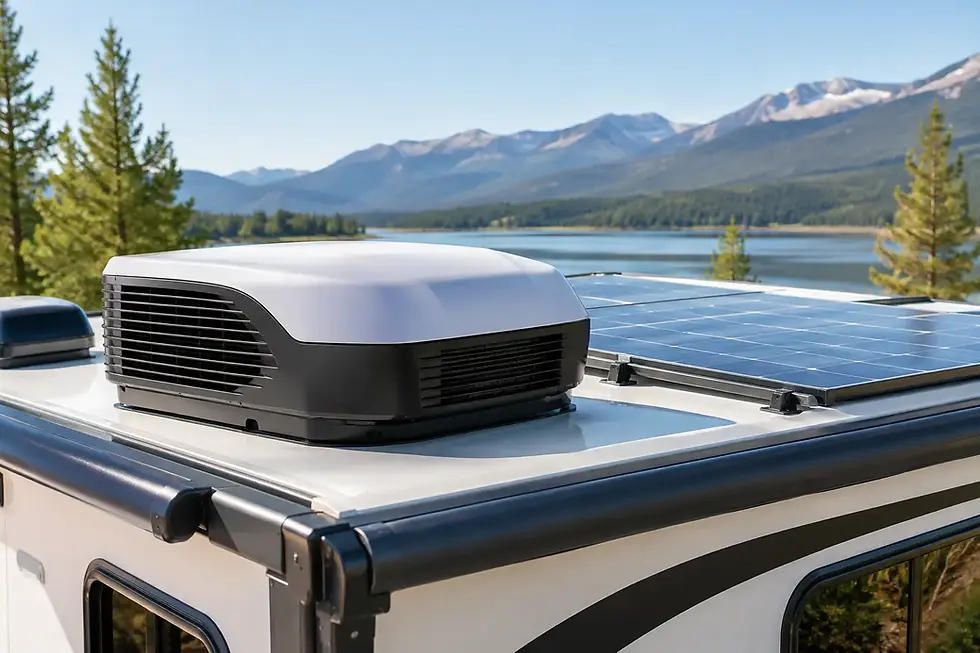
If air conditioning is part of the off-grid plan, the design needs to consider the specific AC unit, expected runtime, outside temperatures, insulation, solar capacity, inverter capability, and battery reserve. There is no responsible one-size-fits-all answer. The same is true for electric cooking appliances, space heaters, and high-wattage hair tools.
12-Volt, 24-Volt, and 48-Volt Systems
Another trend is a broader move toward higher-voltage battery systems for larger electrical builds. At the same power level, higher voltage means lower current. Lower current can reduce cable size requirements and electrical losses, which becomes valuable when an RV has a large inverter and significant battery capacity.
That does not make 48-volt systems the best answer for every rig. A 12-volt system can be an excellent choice for modest loads and straightforward upgrades. A 24-volt system can offer a practical middle ground. The appropriate voltage depends on inverter size, desired loads, physical installation space, existing equipment, and the overall electrical plan.
This is where neat installation work matters. Proper overcurrent protection, cable sizing, disconnects, busbars, battery mounting, and labeling are not cosmetic details. They are what allow a high-capacity system to operate safely and remain serviceable down the road.
What to Ask Before Choosing a Lithium Upgrade
Before selecting a battery, document the electrical equipment you use and the way you camp. Identify the refrigerator type, microwave wattage, air conditioner model, daily internet and computer use, cooking appliances, and any medical or work-related equipment that cannot lose power. Then consider how often you stay without hookups and whether you expect solar to handle most of your recharging.
It also helps to decide what success looks like. For some owners, it means quiet overnight power and no more weak lead-acid batteries. For others, it means working from public land for several days, using the RV like a small home, or extending comfortable travel beyond crowded RV parks.
Power Up RV Solar approaches this by sizing around the actual rig and the actual trip, not around a prebuilt package. That means looking at appliances, charging sources, desired runtime, existing equipment, and future plans before recommending the battery bank.
The most exciting part of lithium battery technology is not a new label or a bigger capacity number. It is the freedom to design an RV electrical system around where you want to wake up next - and to know that your power plan is ready when the campground hookups are not.


Comments